
Taylor County Release Date Meanings
A projected date is a calculation based on sentence data, credits, restrictions, and other facts then known. An actual release date records a completed event. Parole eligibility identifies when parole consideration may begin. Maximum expiration concerns an endpoint in the sentence calculation. None of those labels should be silently changed into another.
Pretrial detention works differently. A person awaiting trial at Taylor County Detention Center may have no computed sentence-release date because departure depends on bond, a court order, holds, and local processing. A county-sentenced person may have a calculation, but the jail and judgment are the right sources. A state prisoner follows KDOC sentence calculations and state law.
- Projected release date
- A changeable estimate calculated from the current record.
- Parole eligibility
- The point when consideration may start, not a promise of parole.
- Maximum expiration
- A sentence endpoint calculation, not necessarily a planned exit.
- Detainer
- A request or hold from another authority that may affect where a person goes next.
Find Taylor County Projected Release Dates
The first task is to identify the custody system. Kentucky Online Offender Lookup, or KOOL, applies to a Taylor County person who entered KDOC custody or community supervision. It is not a universal county booking archive. Someone who bonded out locally or served only a county term may never have a KOOL record.
- Determine whether the person is at TCDC, in KDOC custody, or merely associated with a Taylor County court case.
- For KDOC, search KOOL by name and DOC number, then match the record through available identifiers and photograph.
- Read current status before any date. “In custody” plus a future date remains an in-custody result.
- Copy the future date's exact label and value. Do not rename parole eligibility or maximum expiration as release.
- Review sentence entries and whether Kentucky's violent-offender rules may apply.
- For a county detainee or county sentence, ask TCDC for its existing calculation and obtain the judgment or later order from the court.
- After the event, confirm release through the new status and the responsible agency's release record.
The live KOOL interface was unavailable in the research environment. Current field labels must therefore be read from the live record, not promised from an old example. Official indexed examples suggest that some records can include DOC or PID identifiers, conviction and sentence data, supervision dates, and office assignments.
Note: A Taylor County jail exit time comes from TCDC records even if KOOL later shows state supervision.
Taylor County Release Date Sources
No single source covers every Taylor County release-date question. The current jail roster tells whether a person appears in local custody now, but a released person usually leaves that view. KOOL follows state custody and supervision. Court records explain the orders that shape a local pretrial or sentenced case.
| Situation | Best first source | What to confirm |
|---|---|---|
| Pretrial at TCDC | Jail and Taylor County court | Bond, order, holds, and processing; often no fixed date |
| County sentence | TCDC calculation and judgment | Existing local calculation and later court changes |
| KDOC sentence | KOOL and KDOC records | Exact status, exact future-date label, sentence entries |
| Parole consideration | Kentucky Parole Board | Eligibility, schedule, and decision, not physical release |
| Completed event | Releasing agency record | Actual date, type, facility, and later supervision |
A transfer must remain separate from release. When TCDC sends a sentenced person to KDOC or another authority, local custody ends but the person has not necessarily returned to the community. Follow the receiving system before drawing a conclusion.
Taylor County State Sentence Credits
KRS 197.045 is Kentucky's principal sentence-credit statute. It authorizes statutory good time for qualifying prisoners who observe institutional rules and do not commit offenses or disobey. It also contains detailed meritorious, program, and educational credit provisions, exclusions, forfeiture, and restoration rules.
Those credits help explain why a KDOC projected release date can move. Credits may be earned, withheld, forfeited after discipline, restored under applicable rules, or recalculated. Sentence entries and court orders can also be corrected. A public display is therefore a snapshot of the calculation, not a binding promise.
This state-prison framework must not be copied onto a Taylor County jail sentence. The research found no Taylor-specific county good-time formula. For a county-sentenced person, ask TCDC for the existing calculation and compare it with the judgment. If the agency does not publish the calculation, a records request is the sound route.
The official Kentucky Legislature source for KRS Chapter 439 provides the current parole statutes. The manifest capture below comes from that source and helps place release-date claims against current statutory text.
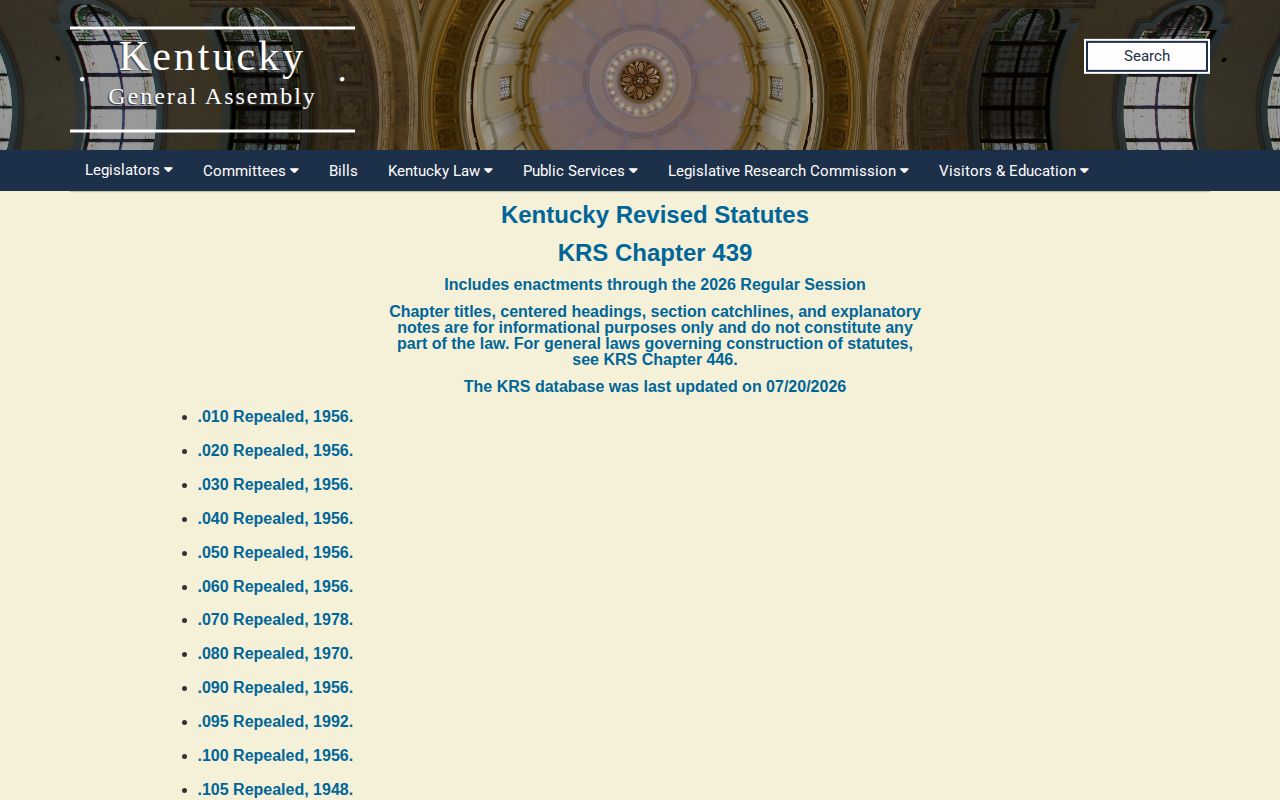
The image is a statutory source, not an individual release record. Apply the current law to the actual offense, date, and sentence before interpreting any future date.
Taylor County Violent-Offender Limits
KRS 439.3401 establishes special parole rules for covered violent offenders. The often repeated 85-percent threshold is not a rule for every Kentucky prisoner. The offense definition, offense date, sentence, exceptions, and special life or Class A provisions all matter.
For covered sentences outside the statute's special provisions, the law generally creates a minimum-service floor before parole eligibility, and credits cannot reduce service below the applicable floor. Even then, parole eligibility remains only a point at which consideration can occur. It is not the date the prison doors will open.
The Kentucky Parole Board maintains official statutes, regulations, schedules, and decisions. Its statutes and regulations page is represented by the capture below.
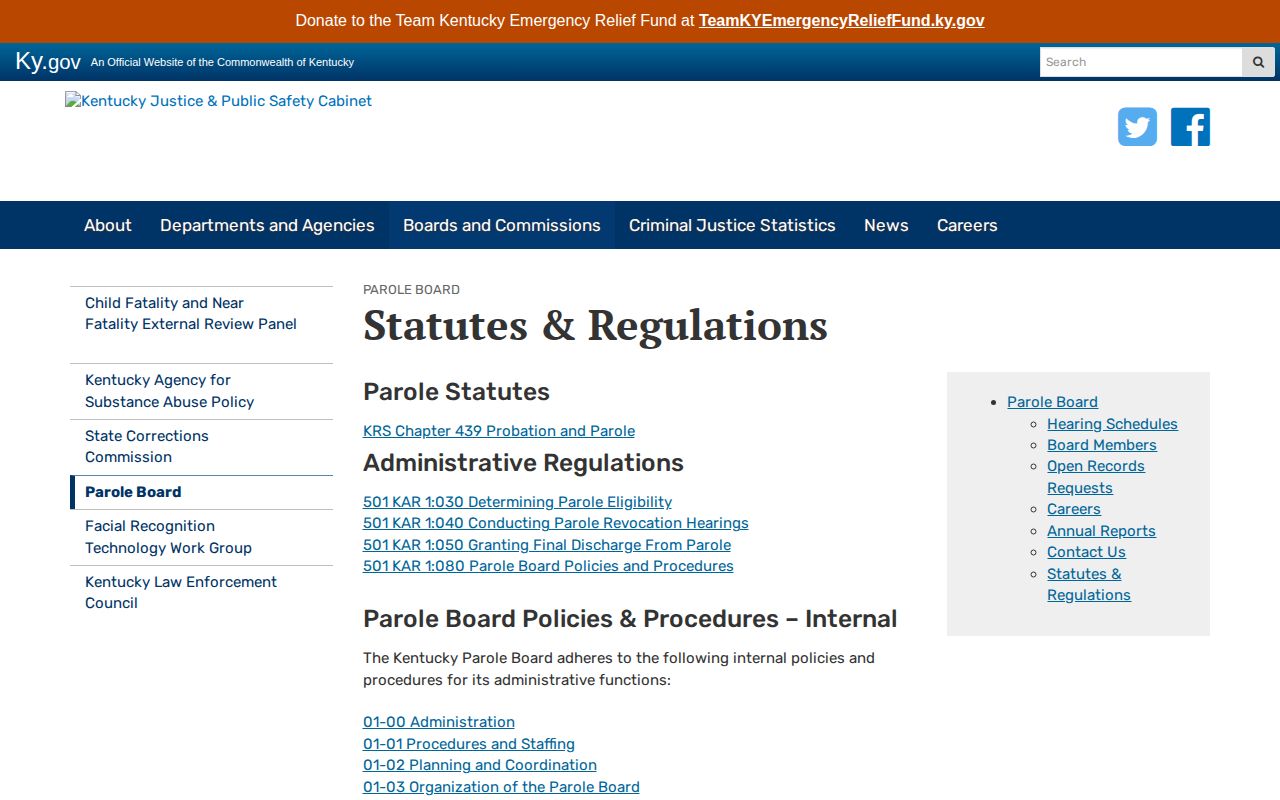
That Board material supports interpretation of eligibility and decision rules. KDOC status and records remain necessary to confirm the later release event.
Taylor County Release Date Changes
A projected Taylor County release date may change for more than one reason. Some factors change the sentence computation. Others affect the practical exit even if a calculated date remains visible. The distinction is crucial when another authority has placed a hold.
| Factor | Possible effect | Confirm with |
|---|---|---|
| Credits earned or restored | May move a qualifying KDOC calculation earlier | KDOC sentence calculation |
| Credit forfeiture or discipline | May move the estimate later | KDOC disciplinary and calculation records |
| Detainer or other hold | May send the person to another authority rather than the community | Holding and receiving agencies |
| Court order or appeal | May modify, correct, or end a sentence | Court file and updated agency record |
| Concurrent or consecutive correction | Can change total time calculations | Judgment and KDOC calculation |
| Parole action or release plan | Approval, denial, deferral, rescission, or plan review can affect timing | Parole Board and KDOC |
| Administrative processing | Can separate a legal milestone from physical departure | Releasing facility |
A board action alone should not be read as the actual release date. An unapproved plan, later Board action, or processing step can remain. Likewise, a date passing without a status change calls for agency confirmation rather than an assumption.
Taylor County Parole Date Distinctions
The Kentucky Parole Board decides parole matters, while KDOC administers custody and community supervision. A hearing date tells when review is scheduled. An eligibility date tells when consideration may begin. A decision records the Board's action. None automatically proves the date of physical release.
Read those records in sequence. First identify the offender and sentence. Next use the current schedule and final decision route. Then return to KOOL for status and to KDOC for the actual release record. If a community office appears, the separate Taylor County post-release supervision path explains how to verify that assignment.
After release on parole, the person may be outside prison but still serving the sentence under conditions. Discharge from supervision is another later event. Keeping each date tied to its own event prevents a common error: treating release, supervision, and final sentence completion as one moment.
Note: Parole eligibility, a Board decision, physical release, and supervision discharge can occur on four different dates.
Taylor County Jail Date Calculations
A pretrial TCDC detainee often has no fixed release date. Bond can be paid, the court can issue an order, or charges can change, yet another hold and release processing may still keep the person in custody. The jail's current roster cannot predict those steps.
For a person serving a county sentence, request the existing jail calculation and the court judgment. Ask for records using identifiers such as full name, date of birth, booking number, and case number when known. The response may identify the sentence basis and actual release once it occurs, subject to the law and any redaction.
Do not apply KRS 197.045 to the county sentence without authority. That statute supports the state-prison credit discussion. Taylor-specific local good-time terms were not verified. The court and TCDC are better sources than an arithmetic estimate built from a sentence length.
Confirm Taylor County Actual Release
Kentucky VINE can add a custody-change alert while a person is held. Taylor County states that its TCDC booking interface sends updates to VINE every 15 minutes, but a notification is still not the durable release record. Vendor lag or error can occur, and KDOC has warned of false release alerts in a vendor incident.
Use VINE as a prompt to check again. For TCDC, call the jail when a current answer is necessary and request the booking or release record for lasting proof. For KDOC, read the updated status and seek existing records showing actual release or discharge, release type, institution, and supervision where releasable.
The full Taylor County VINE inmate check covers search and alert registration. A surprising notification should be reconciled with the jail, KOOL, KDOC, or the court before it is treated as final.
Ultimately, the actual record answers what the estimate cannot: whether the release happened, which agency released the person, why custody ended, and whether supervision or another authority followed. Preserve the exact agency terms in any notes or request.
When requesting proof, ask for an existing record rather than asking staff to predict a date. Supply the full name and known booking, case, or DOC identifier. A narrow request for the actual release date, release type, releasing facility, and supervision status is easier to match to the proper Taylor County or KDOC record.